
Resistance Was Futile: Building LEGO’s U.S.S. Enterprise-D Is a Dream Come True for Star Trek Fans
Tyler Hadyniak, Guest Contributor
TrekNews.net’s Kyle Hadyniak and I recently stopped by the LEGO Flagship Store in New York City, where I promptly gave in to an impulse buy: LEGO’s very first official Star Trek set, the U.S.S. Enterprise-D. The $400, 3,600-piece collector’s set debuted last November and quickly sold out online or slipped into backorder status, so seeing it proudly displayed on the store shelf felt like a small miracle.
As a lifelong LEGO fan who grew up building countless Star Wars sets—and long lamented Star Trek’s absence from LEGO’s lineup—the Enterprise was practically calling my name. Resistance, as it turns out, was futile.
Unboxing and Building
Getting the set back home to Maine was no small feat. The box is heavy and very much not carry-on sized—I learned that the hard way. What it is, though, is thoughtfully designed. The front of the box alone would make an excellent backdrop for the completed model, featuring both a hero shot of the LEGO Enterprise and its on-screen counterpart.
Inside, the experience immediately impressed me. The set includes two instruction books and is well organized, with dozens of smaller bags arranged to be opened sequentially as you build. This smart packaging prevents the dreaded task of sorting through all 3,600 pieces at once—though you’ll still want a large workspace to manage the unopened bags waiting their turn. Once complete, the model measures 10.5 inches (27 cm) high, 23.5 inches (60 cm) long, and 18.5 inches (48 cm) wide.
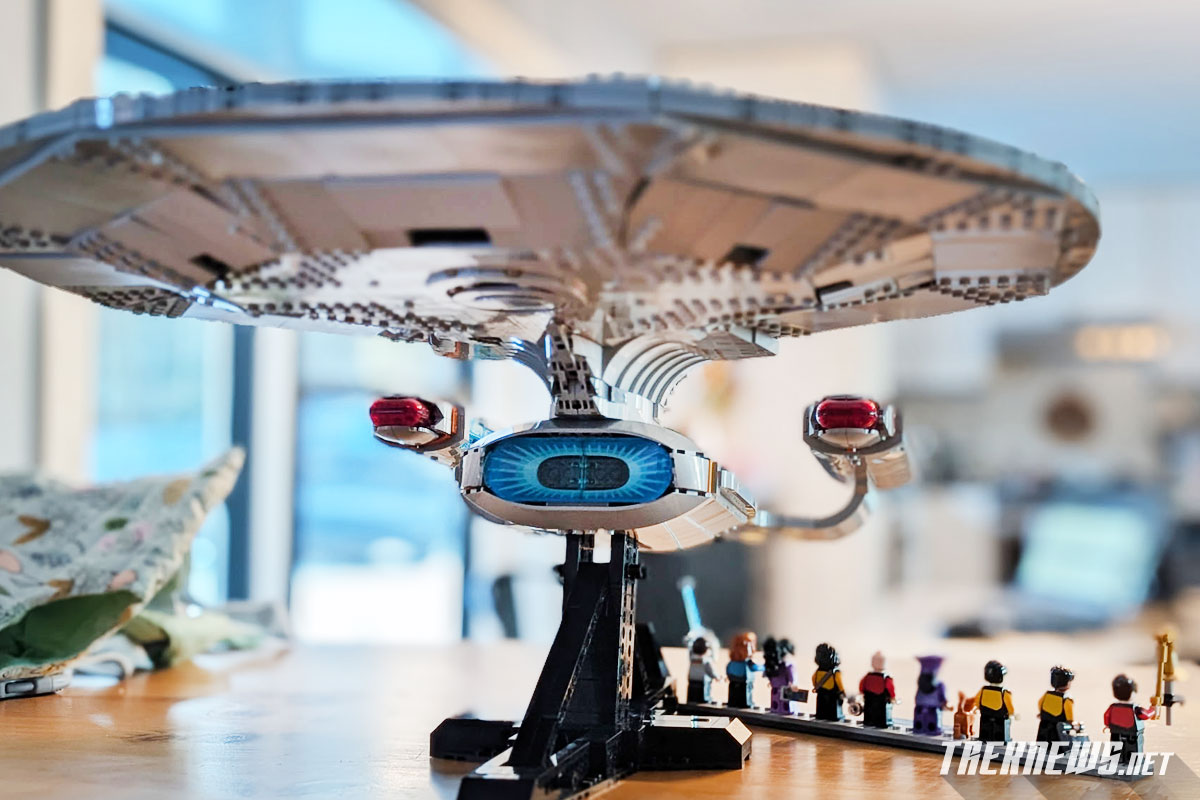
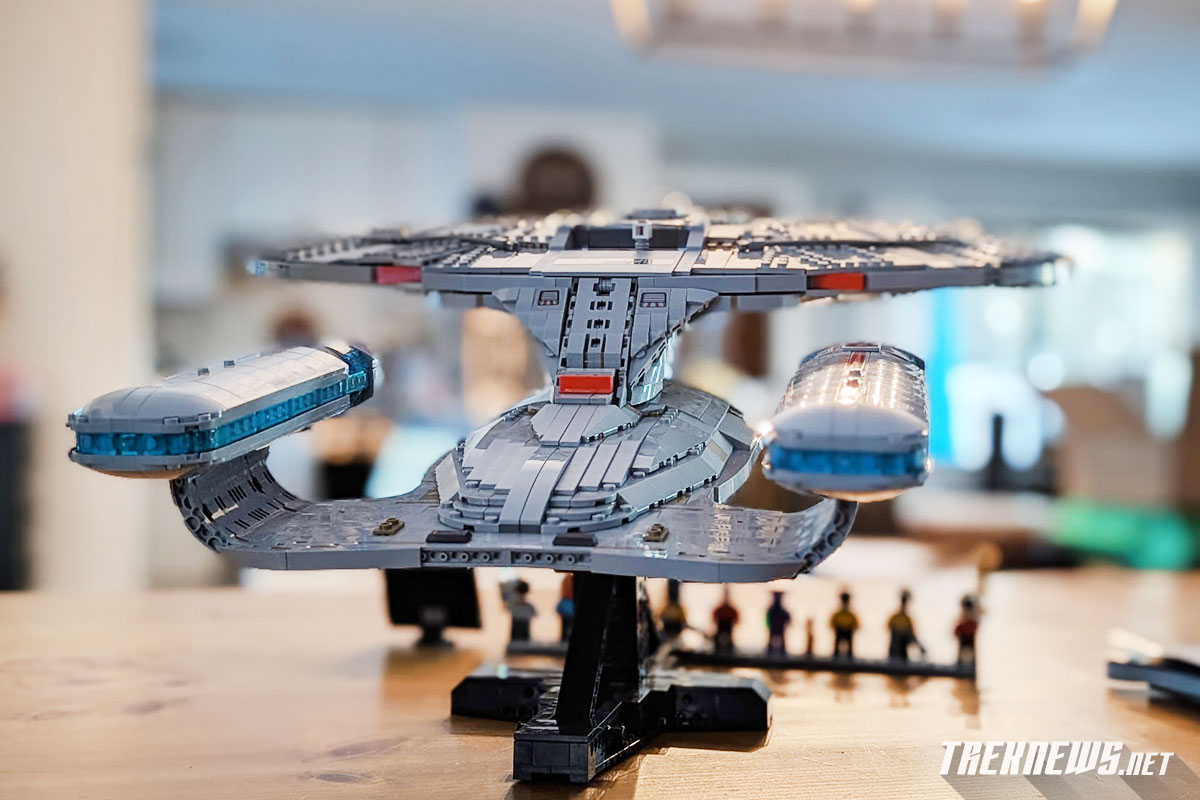
The saucer section is particularly well done, offering a pleasing level of complexity and detail that closely mirrors the real Enterprise-D. As expected, most of the saucer and the drive section are built separately before being joined together. This split construction makes the build ideal for two people and gives LEGO a well-earned win: the ship can literally “saucer separate,” just like its on-screen counterpart.
If you enjoy building LEGO sets with someone as much as you enjoy the finished product, this set shines. The bifurcated build also invites replay value—you can deconstruct the ship and rebuild it later, swapping which section you tackle first. That’s a pretty solid return on your gold-pressed latinum.
The instructions are clear and easy to follow. I only made one mistake, misplacing a section a few studs off where it belonged—entirely my fault. Building together, the process took about five hours; building solo will likely take closer to ten.
Build Highlights
Several moments stood out during the build:
- Placing a tiny dedication plaque inside the bridge. No one will ever see it, but it’s there—and it’s a delightful Easter egg.
- Feeling the deeply satisfying click as the warp nacelles lock into their pylons.
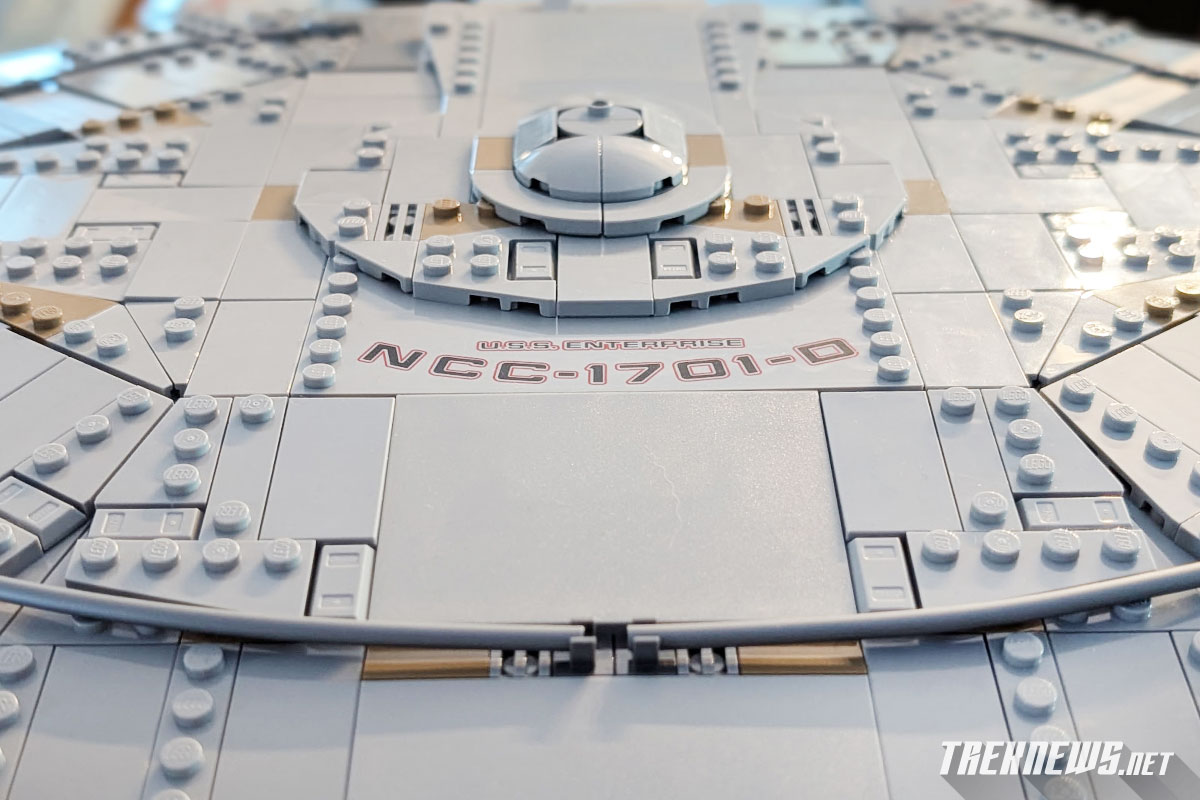
- Wrapping the phaser array around the top of the saucer, beautifully recreating an iconic Galaxy-class detail.
- Showing off the saucer separation feature. Pull a pin near the rear of the saucer and the ship splits cleanly in two. LEGO smartly disguised the pin as a shuttle, making the mechanism feel natural rather than mechanical.
Watching the ship take shape was genuinely exciting. We found ourselves jokingly imagining we were engineers at a LEGO-ized Utopia Planitia Shipyards, realizing piece by piece what we were building—a warp nacelle here, the neck section there, the elegant curve of the saucer slowly emerging. Slapping on the deflector dish at the end felt like the cherry on top (though more on that later).
Once assembled, the set is surprisingly sturdy. It feels like something you can actually handle and “play” with rather than merely admire from a distance. The saucer section carries most of the weight, so it needs a bit more support than the drive section, but adults can absolutely remove it from the stand to recreate a few classic establishing shots—purely in their mind’s eye, of course.
Assembling the Cast
As the build progresses, you also assemble the minifigures—though not all at once. These figures serve as fun checkpoints throughout the process and are displayed on a stand that you build early on. Each character comes with unique accessories that reflect their on-screen roles, making it clear LEGO put real care into these designs.
The set includes nine minifigures and a Star Trek: The Next Generation-branded display tile. Characters include Captain Jean-Luc Picard, Commander William Riker, Lieutenant Worf, Lieutenant Commander Data, Dr. Beverly Crusher, Lieutenant Commander Geordi La Forge, Counselor Deanna Troi, Guinan, and Wesley Crusher. Accessories range from Picard’s teacup and Riker’s trombone (with stand) to phasers, tricorders, a PADD, engineering tools, a portable tractor beam generator—and even Spot the cat.
Qapla’! But Not Quite Perfect
For a set at this price point, quality issues are thankfully nonexistent. That said, I do wish certain elements—like the shuttle bay markings and registry numbers—were printed LEGO pieces rather than stickers. Printed elements would elevate the premium feel even further.
There’s also a notable omission: while the top phaser array is represented by a thin LEGO strip around the saucer, there’s no corresponding array on the underside. Hardcore fans may also notice the deflector dish is slightly misshapen, an issue that stood out when the set was first revealed. While LEGO’s piece limitations likely played a role here—and some fans have already engineered their own fixes—the rest of the model is so faithful that this flaw is easy to forgive.
Final Verdict
Overall, this was an immensely fun and satisfying build, and one that deserves to be proudly displayed. Is it worth the $400 price tag? For me, absolutely. It offered a way to engage with my fandom that simply hasn’t existed before—and I’m fortunate to have the space to showcase it without things feeling cluttered.
If that sounds like you, go ahead and treat yourself. And if you’re feeling especially adventurous, you can even repurpose the Galaxy-class parts into a Nebula-class variant, just as the TNG production team once did.
I’m thrilled that Star Trek has finally entered the LEGO universe, and I sincerely hope this Enterprise-D is just the beginning of a much larger and bolder lineup pulled from the franchise’s long and storied history.
The LEGO Icons Star Trek: U.S.S. Enterprise NCC-1701-D is now available to purchase on Amazon.
Stay tuned to TrekNews.net for all the latest news on Star Trek: Strange New Worlds, Star Trek: Starfleet Academy, Star Trek: Section 31, Star Trek: Lower Decks, Star Trek: Picard, Star Trek: Discovery, Star Trek: Prodigy, and more.