
From 4K spectacle to the stylistic DNA of Star Trek: Discovery and Star Trek: Strange New Worlds, the Kelvin films shaped modern Trek.
When J.J. Abrams’ Star Trek warped onto screens in 2009, it did more than just reboot a legendary franchise; it laid the undeniable blueprint for modern Trek. Years after Chris Pine and company redefined the Final Frontier for a new generation, the Kelvin Timeline trilogy remains a lightning rod for discussion — but its influence on today’s streaming hits, from Discovery to Starfleet Academy, is clear.
As the franchise enjoys a streaming renaissance, there is no better way to appreciate the essential link between classic and contemporary Trek than by revisiting the excellent Star Trek: Trilogy: The Kelvin Collection. Rewatching these films is worthwhile not just because they are enjoyable, high-energy sci-fi action romps, but because they provide the crucial foundation upon which the Star Trek of today is built.
A Technical Masterclass: The 4K/HDR Difference
If you’ve only ever streamed these films or watched the standard Blu-rays, you haven’t truly seen them. The transition to 4K UHD, bolstered by HDR10 and Dolby Atmos, transforms the Kelvin experience into a reference-grade sensory feast. We love a good 4K/HDR home media release, as seen in our glowing reviews of the Star Trek: The Original Motion Picture 6-Movie Collection and the Star Trek: The Next Generation 4-Movie Collection, and the Kelvin Trilogy is no different. In fact, it’s better than any other Star Trek movie in terms of visual and audio presentation.
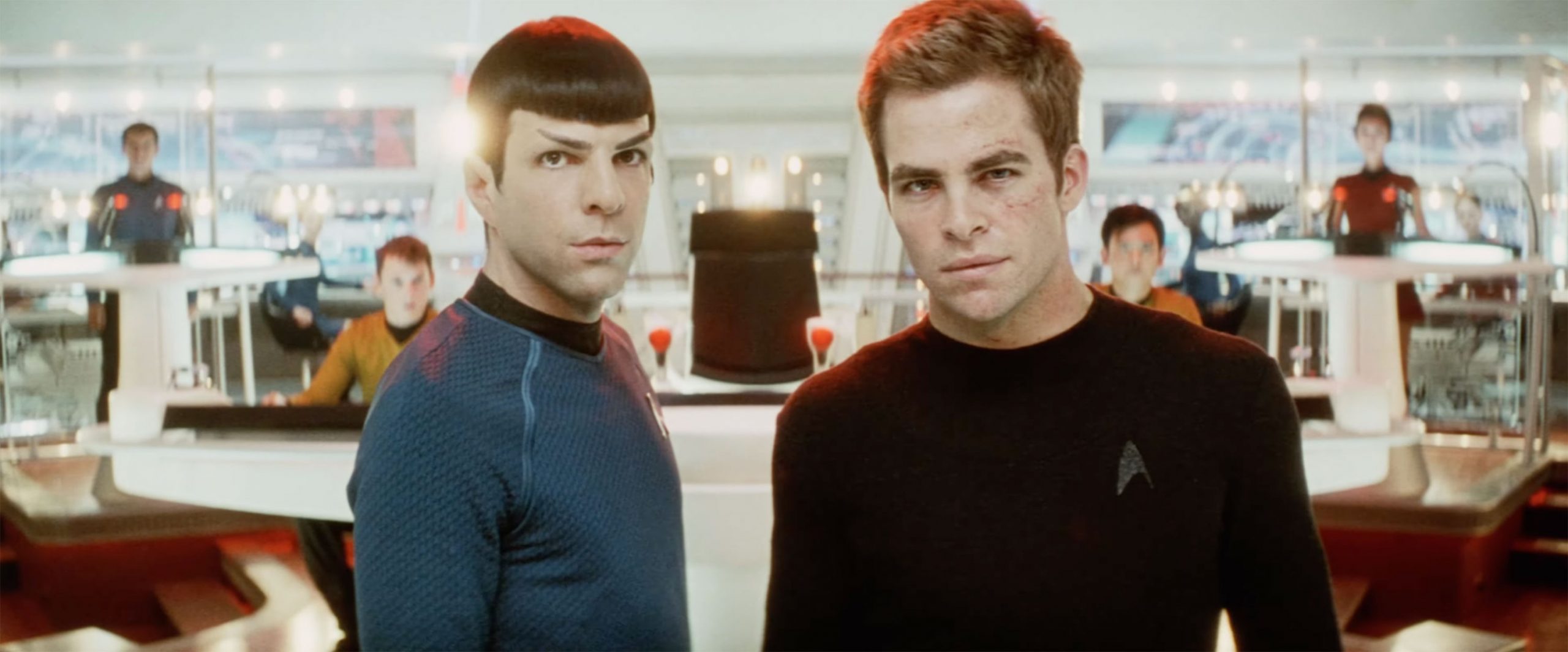
Highlights for us include:
- The Power of HDR: The Kelvin films are famous for their high-contrast lighting. On the 4K discs, the sterile, clinical whites of the Enterprise bridge gleam with a new intensity, while the deep, obsidian shadows of Nero’s Narada or the Vengeance provide a sense of scale and dread that SDR simply cannot replicate. Prepare to have your eyes melt, especially if you have an OLED TV.
- The IMAX Factor: Star Trek Into Darkness remains the crown jewel of this set, even if it’s considered by some to be the weakest movie of the bunch. Shot partially on IMAX film, the 4K disc preserves the shifting aspect ratios, a rare treat among home media releases. When the frame expands during the Nibiru opening or the space jump sequence, the level of detail is staggering. It is, quite simply, “demo material” for any home theater setup.
- Immersive Soundscapes: The Dolby Atmos tracks breathe new life into Michael Giacchino’s soaring scores. From the frantic evacuation of the USS Kelvin to the “Sabotage” swarm in Star Trek Beyond, the spatial audio provides a verticality and punch that grounds you directly in the center of the bridge.
The Blueprint for Modern Trek
Beyond the technical prowess fans can enjoy in the trilogy’s 4K/HDR release, the Kelvin Timeline served as the laboratory for the Star Trek we watch today on Paramount+. If you were around in the months before Star Trek’s 2009 launch, you’ll remember the fervent discourse around the change in style and direction for the franchise. While some purists may still bristle at the shift toward “action-adventure,” the influence of these films on the streaming renaissance is undeniable, and it ultimately invited millions of new fans to the fandom.
1. The Visual Language
The “cinematic” look of Discovery and Strange New Worlds — the spinning camera movements, anamorphic flares, high-production value sets, and flashy on-screen graphics — was pioneered here. The Kelvin films proved that Trek could compete visually with any contemporary blockbuster, a standard that has now become the baseline, more or less, for the streaming shows.
2. Recasting the Legends
Before Chris Pine, Zachary Quinto, and the others in the Kelvin cast stepped into the shoes of their legendary predecessors, the idea of recasting any Star Trek legend felt like sacrilege. Their success proved that the characters were bigger than any one actor. This directly cleared the path for the incredible performances of Anson Mount, Ethan Peck, Celia Rose Gooding and others in modern Trek who embody previously established characters.
3. The Narrative Bridge
J.J. Abrams and company threw fans a bone when they ensured the destruction of Romulus in the 2009 film wasn’t just a plot device to create an alternate timeline — it became a foundational pillar of the Prime Timeline’s history. Beyond being the catalyst for Leonard Nimoy’s return to the franchise, this event ultimately served as the inciting incident for the entire first season of Star Trek: Picard, creating a fascinating bridge between the big-screen reboot and the small-screen legacy. And don’t forget the Kelvin Timeline’s shoutout in season three of Discovery, where a temporal soldier crossed between the two timelines. The canonical legacy of the Kelvin Timeline is alive and well in modern Trek.
4. The Builders of Style
The continuity between the Kelvin Timeline and the modern streaming era is most evident in the creative “brain trust” that migrated from the big screen to Paramount+. At the helm is Alex Kurtzman, who co-wrote the first two films and has served as the architect of the entire franchise for years now, ensuring that the kinetic, high-stakes energy of the movies remains a key part of the television shows. This transition was bolstered by key creatives like Akiva Goldsman and Heather Kadin, who translated the “blockbuster” scale of the 2009 reboot into a serialized format. Behind the scenes, the visual DNA was preserved by legendary designers like Neville Page (who has a great book showcasing his talent) and John Eaves. Their work on the Kelvin films — ranging from intricate creature prosthetics to the sleek, modernized starship silhouettes — became the literal blueprint for the aesthetic seen in Discovery and Strange New Worlds.
By carrying over these specific skills in production design, creature effects, and cinematic pacing, this creative cohort successfully bridged the gap, proving that the polished, high-octane “look” of the Kelvin movies was not just a detour, but the new standard for 21st-century Star Trek.
The Kelvin Timeline films were a “shot in the arm” for a franchise that many felt had stalled after Enterprise. Whether you’re a lifelong fan or a recent newcomer, revisiting these movies on 4K physical media offers a clear throughline between Trek’s past and present.
The lens flares might be bright, but the future of Star Trek is even brighter because of the Kelvin Timeline movies.
You can buy the Star Trek: Trilogy: The Kelvin Collection on Amazon.
Stay tuned to TrekNews.net for all the latest news on Star Trek: Strange New Worlds, Star Trek: Starfleet Academy, Star Trek: Section 31, Star Trek: Lower Decks, Star Trek: Picard, Star Trek: Discovery, Star Trek: Prodigy, and more.